
The Missing Mass Chronicles: AT2022zod
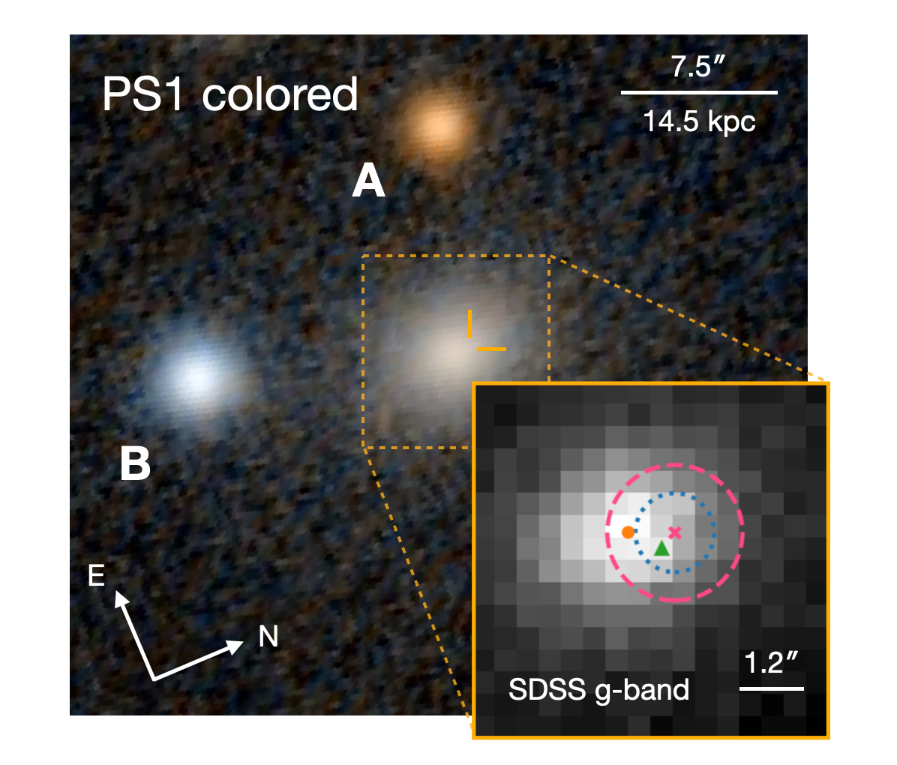
Here we present AT2022zod, an extreme, short-lived optical flare in an elliptical galaxy at z = 0.11, residing within 3 kpc from the galaxy’s centre. Its luminosity and ∼30-day duration make it unlikely to have originated from the host galaxy’s central supermassive black hole (SMBH), which we estimate to have a mass of ∼ 108 M⊙. Assuming that the emission mechanism is consistent with known observed TDEs, we find that such a rapidly evolving transient could either be produced by a MBH in the intermediate-mass range or, alternatively, result from the tidal disruption of a star on a non-parabolic orbit around the central SMBH.
Addressing the ELEPHANT in the sky

An automated pipeline for identifying extragalactic hostless transients.
During the seventh edition of the COIN Residence Program…
The road to interdisciplinarity

How Have Astronomers Cited Other Fields in the Last Decade?
One of COIN’s main goals is to explore the frontiers of interdisciplinarity inspired by astronomy.
Data challenges on space: perspectives from Brazil and China

Debate about novel technologies in Astronomical research and their connections with the latest developments in artificial intelligence.
COIN unravels details in one of the Milky Way’s spiral arms
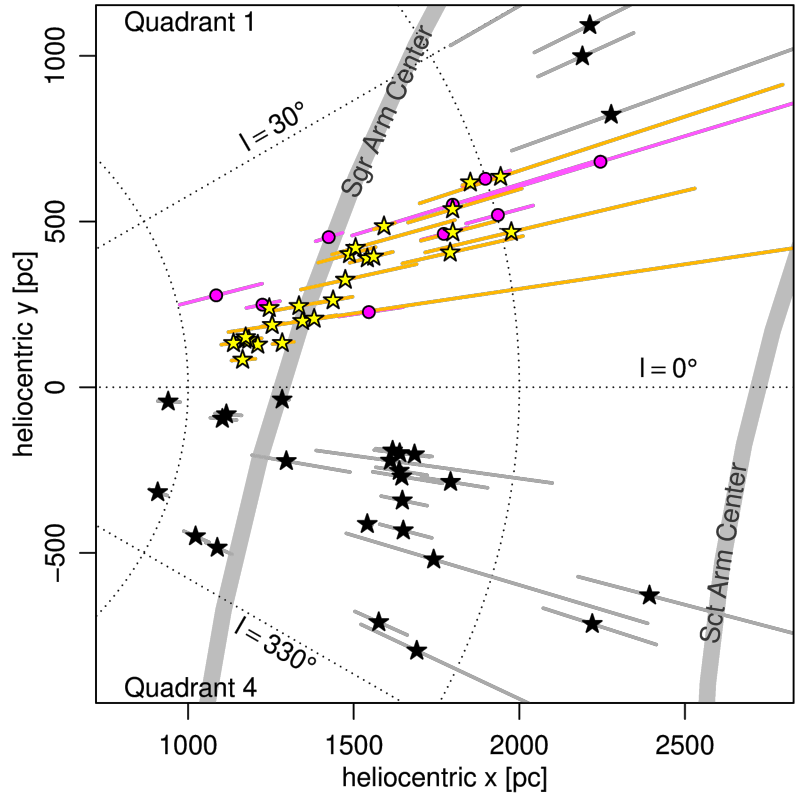
A high pitch angle structure in the Sagittarius Arm – Since the last edition of the COIN Residence Program, researchers working in the SPICY project had a suspicion that there was something not quite expected
COIN model presented to the Science of Team Science community

COIN presentation at the 2021 International Conference for Science of Team Science
First COIN-music project is live!

Music composition inspired by Astronomy – COIN has always explored the potential of Astronomy to inspire creativity in different levels…
Mapping stellar nurseries in the Milky Way

One of the largest compilation of young stars identified by the COIN Residence Program #6 team.
Connecting emptiness
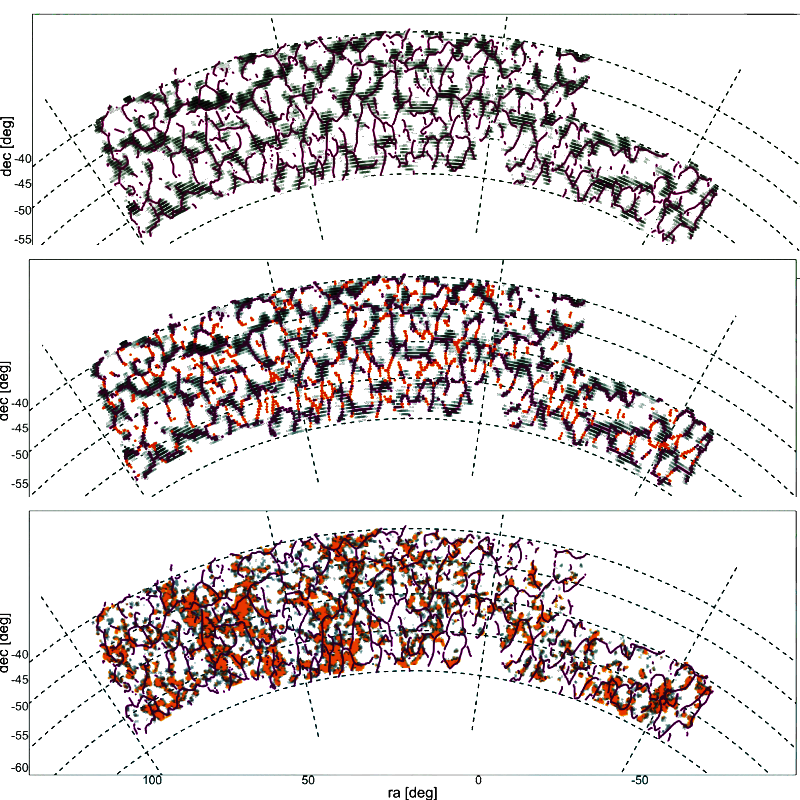
From left to right, data projection form the 2df Galaxy survey, visualization of the Illustris simulation, spatial distribution of registered crimes in the city of Chicago. In searching for a robust statistical method to map large regions of almost empty space formed alongside the large-scale structure of our Universe, researchers of the Cosmostatistics Initiative (COIN) found inspiration […]
COIN-Focus : TOLIMAN mission

The Cosmostatistics Initiative (COIN) has entered into a strategic agreement with the TOLIMAN collaboration to enable the detection of exoplanets from diffractive pupil based relative astrometry from space.