
SAGUI: Segmentation Analysis of hyperspectral astronomical images — Application to the JADES in GOODS-South
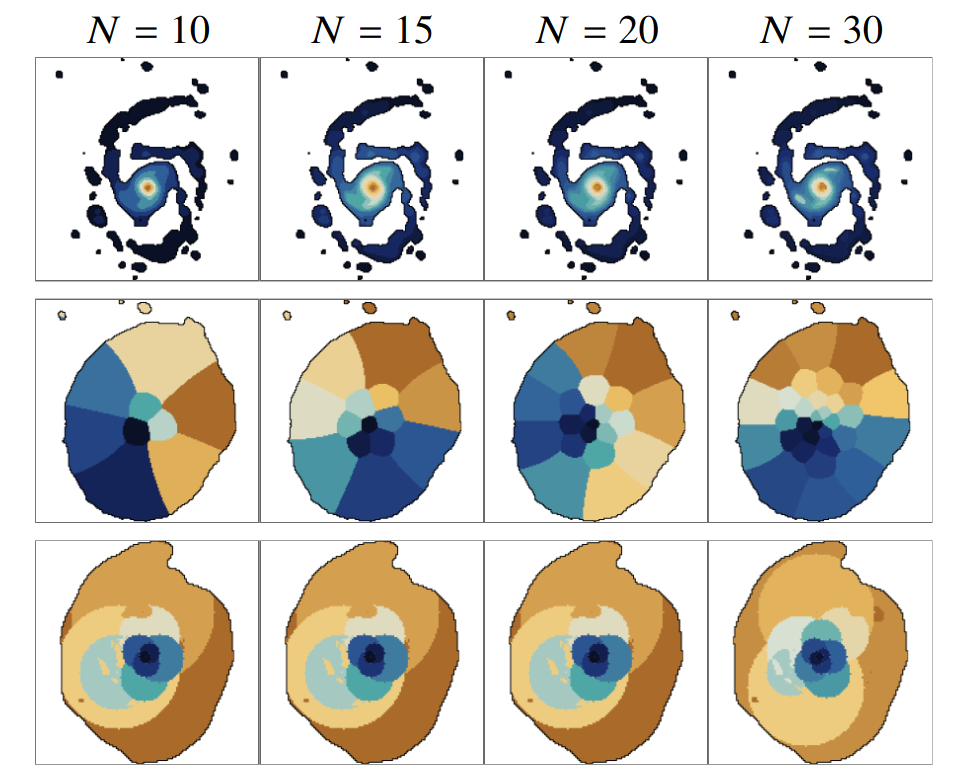
Galaxies exhibit a wide variety of internal structures, whose identification and characterization require efficient segmentation techniques. We present a suite of methods for the analysis of multi-band imaging data, with extensions to integral-field spectroscopy, developed under the umbrella of SAGUI: a modular framework for spatially resolved galaxy analysis. Building on the spectro-spatial paradigm introduced by CAPIVARA for integral-field spectroscopic data, sagui generalizes this approach to imaging datasets, enabling a coherent, pixel-level treatment of spatial and spectral information across multiple bands. The method follows a two-stage strategy. In the first stage, a starlet-based decomposition is employed to identify and mask spatial structures across multiple scales while suppressing noise.
In the second stage, a spectral-similarity analysis partitions the image into coherent pixel groups that preserve spectral consistency. We demonstrate our approach across a diverse range of galaxy morphologies, highlighting its ability to characterize complex spatial structures, including clumps, bars, interacting systems, and low-surface-brightness features. As a case study, we apply the method to ten morphologically diverse galaxies from the James Webb Space Telescope Advanced Deep Extragalactic Survey (JADES) in the GOODS–South field. sagui is released under an MIT license and is available in this repository.
Full citation: de Souza et al., 2026, arXiv:astroph/2604.18812
This project is a result from COIN Residence Program #8 – Brazil/2025.


- Rafael S. de Souza, U. Hertfordshire (UK)
- Andressa Wille, UFRGS (Brazil)
- Shravya Shenoy, U. Hertfordshire (UK)
- Alberto Krone-Martins, U. California Irvine (USA)
- Aarya A. Patil, MPIA (Germany)
- Celine Boehm, U. Sydney (Australia)
- Ana Chies Santos, UFRGS (Brazil)
- Reinaldo R. Rosa, INPE (Brazil)
- Thalis Pessi, ESO (Chile)
- Emille E. O. Ishida, CNRS/UCA (France)
- Kristen Dage, Curtin U. (Australia)
- Lilianne Nakazono, U. Sao Paulo (Brazil)
- Rupesh Durgesh, Industry (Germany)
- Phelipe Darc, CBPF (Brazil)