
“Le seul véritable voyage, le seul bain de Jouvence, ce ne serait pas d’aller vers de nouveaux paysages, mais d’avoir d’autres yeux, de voir l’univers avec les yeux d’un autre, de cent autres, de voir les cent univers que chacun d’eux voit, que chacun d’eux est.”
Marcel Proust, La Prisonnière (The Prisoner), vol. 5 of In Search of Lost Time
Galaxies are not made of sharp boundaries, and their light spills across bars, spiral arms, clumps, bridges, and diffuse outskirts. Yet, if we want to understand how galaxies grow and transform, we need ways of dividing them that do more than follow brightness alone.
During our 2025 annual meeting, held for the first time on the shores of Brazil, we developed SAGUI, a framework designed to segment multi-band galaxy images by combining morphology and spectral information. The method first uses a starlet-based multiscale decomposition to identify the main galaxy structure, and then groups pixels according to the similarity of their spectral energy distributions across the available bands.
We applied SAGUI to eleven galaxies from the James Webb Space Telescope Advanced Deep Extragalactic Survey (JADES) in GOODS-South, including spirals, interacting systems, barred galaxies, and a dedicated low-surface-brightness case. Across these examples, the method recovers bars, clumps, asymmetric arms, and faint structures while preserving similarity in SED shape. When combined with spatially resolved SED fitting, these segmentations become maps of stellar populations, dust, and star formation, offering a more coherent view of the internal life of galaxies.
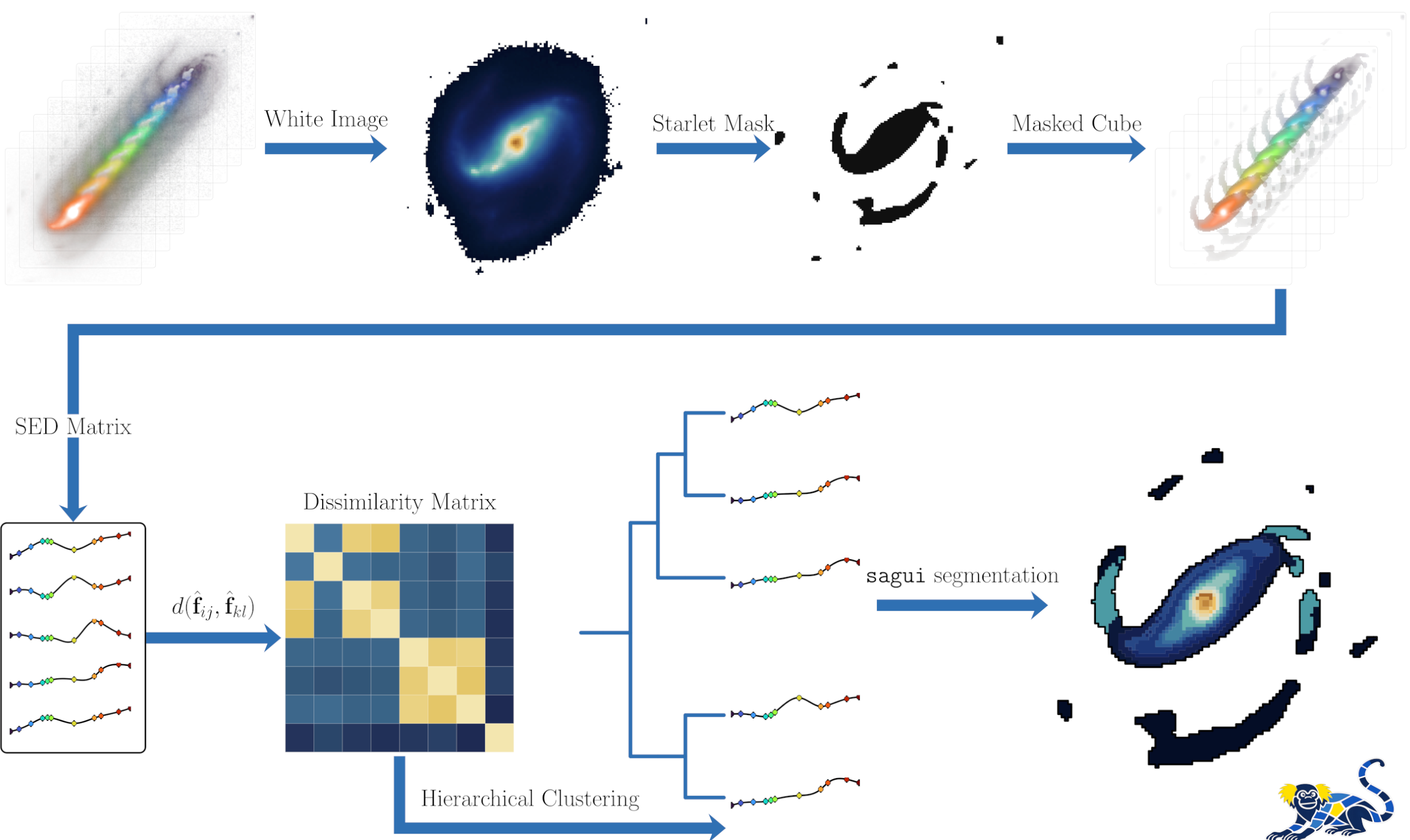
One of the most delicate cases is a pair of galaxies linked by a faint diffuse bridge, barely visible above the background. Features like these are easy to erase in standard preprocessing. To address them, SAGUI also incorporates a copula-based statistical treatment aimed at recovering low-surface-brightness structures whose signal is weak in any one band, but coherent across several.
SAGUI is part of a broader effort at COIN to bring ideas from different areas of mathematics, statistics, and astronomy into a common language. In the era of deep, multi-band surveys, learning how to separate galaxy light into meaningful regions is not only a technical task. It is also a new way of asking how galaxies are assembled.